
Industry News
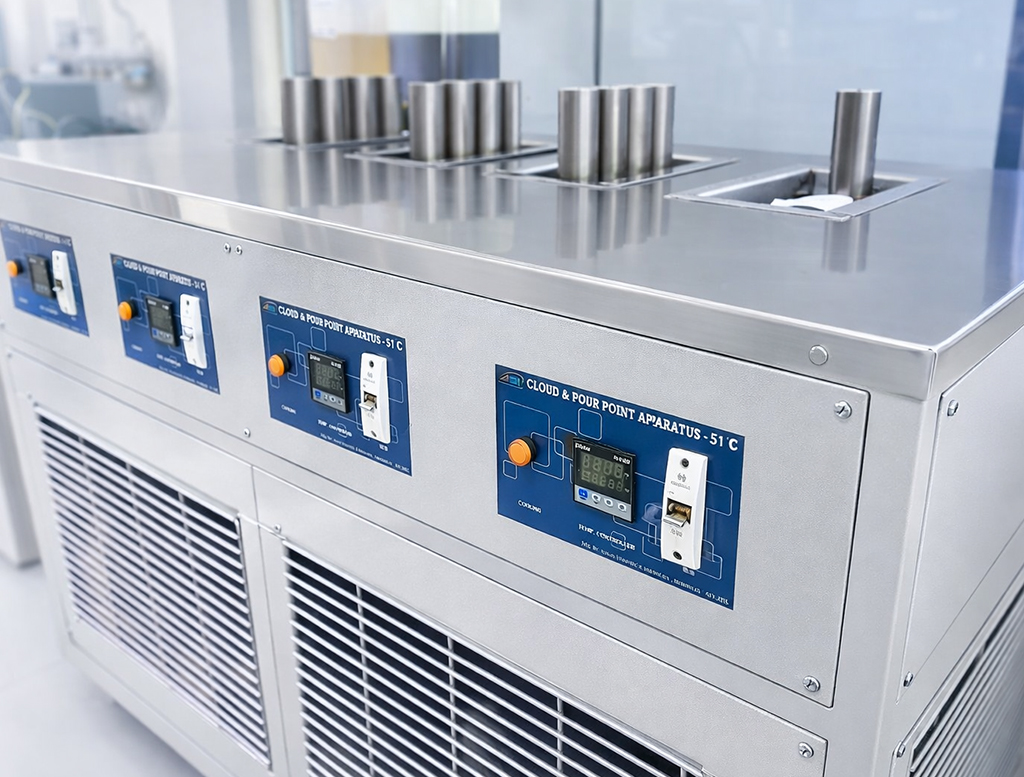
Pour point testing is a critical low-temperature performance test used to determine the lowest temperature at which a fuel or oil remains fluid and capable of flowing. Below this temperature, wax crystals form, causing the fuel or oil to gel and lose mobility. Pour point testing is essential for industries operating in cold climates or low-temperature conditions, including automotive, marine, aviation, power generation, oil & gas, and industrial manufacturing.
At low temperatures, fuels and oils with poor cold-flow properties can thicken, solidify, or stop flowing entirely, leading to blocked fuel lines, pump failures, poor engine starting, and lubrication starvation. Pour point testing assesses cold-weather operability, ensuring fuels and lubricants perform reliably during storage, transport, and use. It also helps detect issues related to wax precipitation, improper blending, or off-spec fuel quality.
Pour point limits are specified in various national and international standards to ensure safe and reliable operation in cold environments. These include:
Pour point testing is especially critical for winter-grade fuels, low-temperature lubricants, and fuels used in high-altitude or cold-region operations.
Pour point testing is routinely performed on:
These methods provide reliable and repeatable results for quality control, compliance, and performance assessment.
Atlas Lab offers accurate and reliable pour point testing for fuels and oils, supporting clients across marine, automotive, power generation, oil & gas, and industrial sectors. As a NABL-accredited and ISO/IEC 17025-certified laboratory, Atlas Lab conducts pour point testing in accordance with ASTM, ISO, IP, BIS, and OEM standards, delivering precise results with fast turnaround times.
Our testing helps clients:
Contact Atlas Lab today for professional pour point testing services for fuels and oils, and ensure reliable performance in cold-temperature operations.
Phone :+91 9324631646
WhatsApp : +91 9324631646
Email : contact@atlaslab.in

The cement industry operates under some of the harshest conditions in industrial manufacturing. Equipment such as rotary kilns, vertical roller mills,
Read more about Lube Oil Testing for the Cement Industry
The steel industry operates some of the most demanding and high-load machinery in the industrial sector. Equipment such as blast furnaces,
Read more about Lube Oil Testing for the Steel Industry