
Industry News
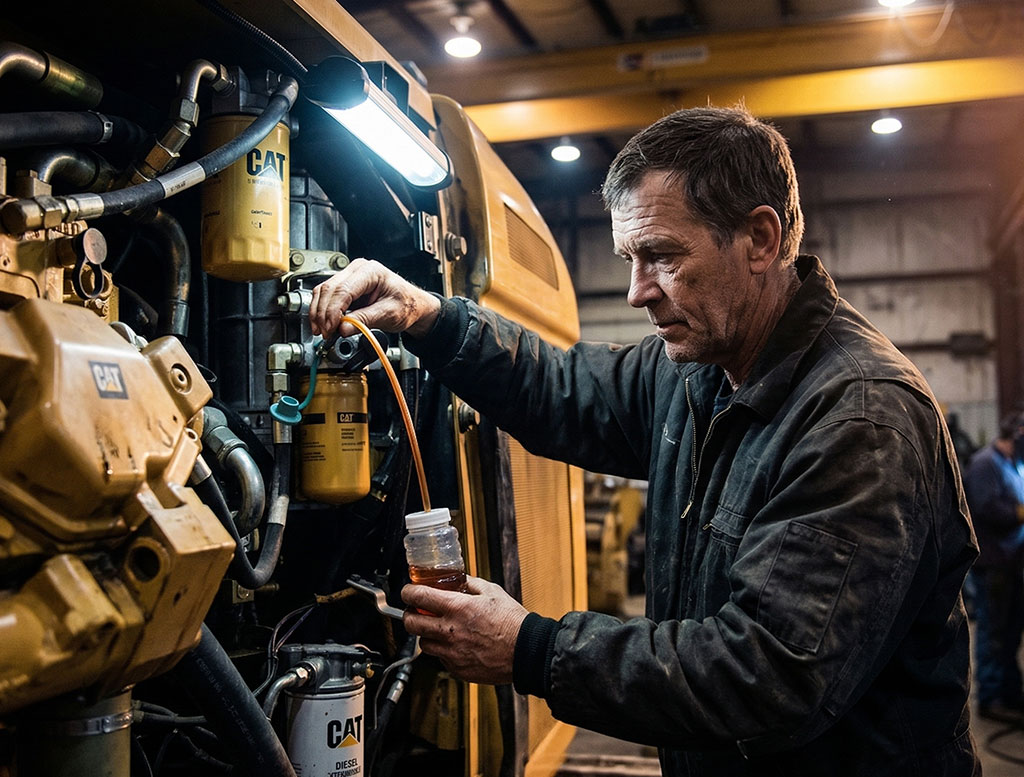
Lube oil analysis is one of the earliest and most practical ways to detect developing machine failure because the oil sits directly in the load zone, the wear zone and the contamination pathway. When analyzed correctly, it can reveal whether the lubricant is degrading, whether contaminants are entering the system and whether the machine is producing abnormal wear debris. That three-part framework is fundamental to professional oil analysis and is the reason oil analysis can identify problems well before catastrophic failure occurs.
The real advantage of lube oil analysis is that it often detects the cause of failure progression, not just the symptoms. Vibration may show that a fault is already active. Oil analysis, by contrast, can often show the wear mode, contamination source or lubrication problem that is driving the fault in the first place. This is especially valuable in gearboxes, hydraulic systems, compressors, turbines and engines where contamination control and lubricant health directly affect reliability.
Early machinery failure rarely begins as a dramatic event. It usually starts as one or more small changes in the lubricant environment:
Individually, these may look minor. In trend form, they often tell a very clear story. Recent guidance on oil analysis and particle counting emphasises that trending gradual changes is one of the most effective ways to spot developing problems before they become outages.
A seasoned analyst does not look at an oil report as a random list of lab values. The report is typically interpreted in three linked categories:
1. Oil condition
These tests show whether the lubricant itself is still healthy. Common indicators include viscosity, oxidation, acid number and additive condition. If the oil is chemically degraded or out of grade, it may no longer provide the film strength or thermal stability required to protect the machine.
2. Contamination
These tests show what has entered the oil from the outside or from adjacent systems. This includes dirt, water, coolant, fuel and process contamination. In many industrial assets, contamination is the main driver behind wear acceleration and premature failure. Particle count and moisture analysis are particularly important here.
3. Wear
These tests show what the machine is producing as surfaces begin to distress. Elemental spectroscopy, ferrous density, patch analysis and analytical ferrography help identify whether wear is normal, abnormal or severe, and in some cases, what wear mechanism is involved.
That structure matters because early failure detection is rarely about one number crossing a limit. It is about reading oil condition, contamination and wear together.
Abnormal wear metals
An upward trend in iron, copper, lead, chromium or aluminium can indicate component-specific wear before the machine becomes noisy or unstable. Spectrometric analysis is one of the most widely used screening tools for detecting fine wear metals in used oil, and it is especially effective when results are trended rather than read in isolation.
For experienced analysts, the metal type matters. Iron may point toward gears, shafts or ferrous rolling surfaces. Copper and lead can indicate bearing distress. Chromium may suggest ring or hard-surface wear. The pattern often tells more than the absolute number.
Rising particle count
A worsening ISO cleanliness code is often one of the earliest indicators that something has changed inside the machine. In filtered systems, a spike in particle count may point to external contamination, filter bypass, poor breather control or active internal wear. Best-practice guidance specifically calls out ISO cleanliness and micron-by-micron particle counts as critical indicators for contamination and machine health.
Water ingress
Water is a highly destructive contaminant because it reduces film strength, accelerates corrosion, promotes additive depletion and can contribute to cavitation or sludge formation. Even small amounts of water can materially affect lubricant performance, particularly in turbines, hydraulics and circulating systems. A water increase is often not just a fluid issue but a direct warning of seal failure, condenser leakage, breather problems or condensation control issues.
Viscosity shift
If viscosity moves significantly above or below the target, the machine may be operating with compromised lubrication film thickness. A rise may suggest oxidation, soot or contamination. A drop may suggest shear, thermal cracking or fuel dilution. In either case, the lubricant may no longer be protecting the asset as designed.
Ferrous density increase
One of the limitations of elemental spectroscopy is that it is strongest on very fine wear particles and less representative of larger debris. Ferrous density helps fill that gap by responding to larger ferrous wear particles that may indicate an active distress event. References on oil analysis alarms and large-particle monitoring note that ferrous density becomes particularly valuable when abnormal wear is producing particles too large for standard elemental analysis to capture well.
When screening tests suggest abnormal wear, wear debris analysis becomes one of the most powerful next steps. Analytical ferrography and related microscopy-based methods allow the analyst to examine particle size, shape, texture, colour, and distribution. That makes it possible to distinguish between cutting wear, sliding wear, fatigue wear, corrosive wear and severe adhesive distress.
This is where early failure detection becomes far more precise. Instead of just saying “iron is high,” the analyst can often determine whether the machine is experiencing abrasive ingress, boundary lubrication distress, rolling contact fatigue or active surface spalling. One technical article on machinery damage identifies abrasion, corrosion, fatigue and boundary lubrication as four major wear mechanisms behind many failures, which aligns closely with what advanced wear debris analysis is designed to expose.
A seasoned reliability program often sees oil analysis detect issues such as:
These are not theoretical benefits. Multiple technical sources emphasise that oil analysis and particle counting should be used together, specifically to reveal abnormal wear, contamination and developing failure modes early enough for intervention.
Experienced practitioners know that early failure detection improves sharply when tests are layered. A robust program may combine:
One long-standing technical principle in oil analysis is that these methods are most powerful when used in combination, because each sees a different portion of the failure picture.
This is why mature oil analysis programs do not stop at “wear metals high.” They ask a more useful sequence:p
That is how oil analysis moves from condition monitoring to diagnostics.
Even the best lab tests are only as good as the sample. Reliable early warning depends on sampling from the correct location, at consistent intervals, under stable operating conditions, and with a clean technique. Practical guidance on oil analysis programs stresses routine sampling discipline as essential for turning lab results into meaningful diagnostic trends.
Poor sampling can flatten trends, mask contamination entry, and delay recognition of failure progression. In high-criticality systems, that is not a laboratory problem; it is a reliability risk.
The real value of lube oil analysis is not that it confirms failure after the fact. It is that it gives maintenance teams a chance to intervene while the fault is still small, localised, and correctable. Done well, oil analysis helps move response from emergency repair to planned correction, often before the machine crosses into severe wear, heat generation, vibration escalation or collateral damage.
Atlas Lab provides lube oil analysis designed to detect developing failure modes before they become shutdowns. By evaluating lubricant condition, contamination control and machine wear together, our testing helps identify early signs of distress, support root-cause investigation and guide timely corrective action.
From hydraulic systems and industrial gearboxes to compressors, engines and critical rotating equipment, Atlas Lab helps clients turn oil data into practical maintenance intelligence.
Reach out to Atlas Lab to build a lube oil analysis program that improves fault detection, protects equipment and reduces unplanned downtime.
Phone :+91 9324631646
WhatsApp : +91 9324631646
Email : contact@atlaslab.in

The cement industry operates under some of the harshest conditions in industrial manufacturing. Equipment such as rotary kilns, vertical roller mills,
Read more about Lube Oil Testing for the Cement Industry
The steel industry operates some of the most demanding and high-load machinery in the industrial sector. Equipment such as blast furnaces,
Read more about Lube Oil Testing for the Steel Industry