Industry News
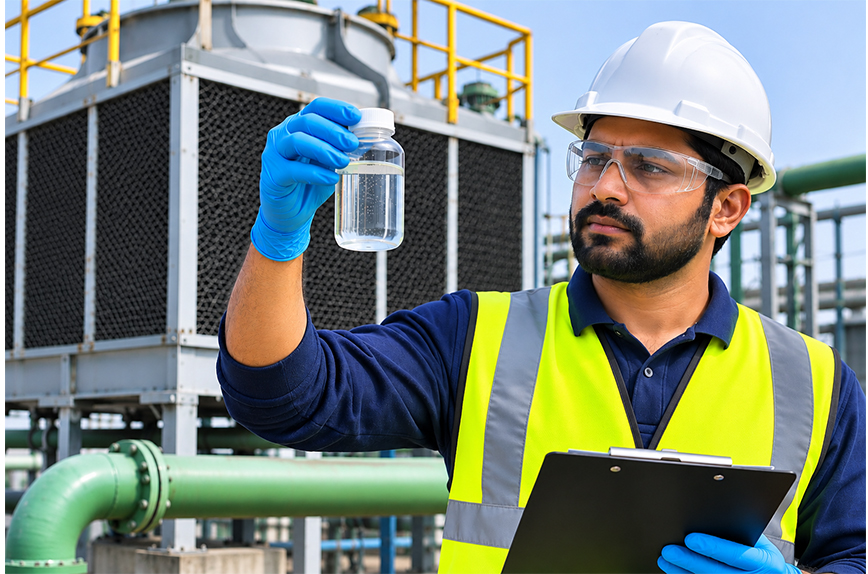
Cooling towers are essential components of HVAC systems, power plants, manufacturing facilities, and industrial cooling processes. However, poor water quality can lead to scaling, corrosion, bacterial contamination, and reduced heat transfer efficiency, resulting in higher operating costs and equipment failures.
Regular cooling tower water testing helps identify potential problems early, optimise chemical treatment, and maintain efficient system operation.
Here are the 10 most important cooling tower water testing parameters and why they matter.
pH indicates the acidity or alkalinity of cooling tower water and directly influences corrosion rates, scale formation, and chemical treatment efficiency.
Low pH can accelerate corrosion of metal surfaces, while excessively high pH increases the risk of calcium carbonate scaling. Maintaining the appropriate pH range also ensures effective performance of corrosion inhibitors and biocides.
Why test? To maintain chemical balance, prevent equipment corrosion, and minimise scale formation.
TDS measures the total concentration of dissolved minerals, salts, and other substances present in cooling tower water.
As water evaporates during cooling, dissolved impurities become concentrated in the circulating water. Excessive TDS can increase the potential for scaling, corrosion, and fouling, depending on the composition of the dissolved substances.
Why test? To monitor dissolved impurities, optimise blowdown, and maintain water quality within recommended operating limits.
Electrical conductivity measures the ability of water to conduct electricity, which is influenced by the concentration of dissolved ions.
It is one of the most important operational parameters for cooling towers because evaporation continuously increases dissolved salt concentrations. Conductivity monitoring helps operators determine when blowdown is required to control these concentrations.
Why test? To monitor cycles of concentration, optimise blowdown frequency, and reduce unnecessary water consumption.
Total hardness measures the concentration of calcium and magnesium ions in water.
High hardness, particularly when combined with elevated alkalinity and temperature, can cause mineral scale deposits on heat exchangers, pipelines, and cooling tower surfaces. These deposits act as insulating layers, reducing heat transfer efficiency and increasing energy consumption.
Why test? To identify scaling potential, evaluate water treatment effectiveness, and protect heat-transfer equipment.
Total alkalinity measures the water's capacity to neutralise acids, primarily due to bicarbonates, carbonates, and hydroxides.
High alkalinity can increase calcium carbonate scaling potential, especially in systems operating at elevated pH and temperature. Low alkalinity may reduce buffering capacity, making pH more susceptible to fluctuations.
Why test? To maintain stable water chemistry, control scaling tendencies, and optimise chemical dosing.
Chloride is a dissolved ion commonly present in makeup water and becomes concentrated during cooling tower operation.
Elevated chloride concentrations can increase corrosion risks, particularly pitting and crevice corrosion in susceptible stainless steels. Chloride levels are especially important in cooling systems containing stainless steel heat exchangers, pipelines, and other metallic components.
Why test? To assess corrosion potential, protect metal components, and monitor salt accumulation in circulating water.
Sulphate is a naturally occurring dissolved ion found in many groundwater and industrial water sources.
High sulphate concentrations can contribute to mineral scaling, particularly calcium sulphate deposits under suitable water chemistry conditions. Sulphates may also contribute to corrosion-related concerns depending on system conditions and microbial activity.
Why test? To evaluate scaling risks, monitor dissolved salts, and support effective corrosion management.
Silica is commonly found in borewell water, groundwater, and other industrial water sources.
As cooling tower water becomes concentrated through evaporation, silica levels increase and may lead to hard deposits on heat exchangers and cooling surfaces. Silica-based deposits can be difficult to remove using conventional cleaning methods and may significantly reduce heat transfer efficiency.
Why test? To monitor silica buildup, prevent difficult-to-remove deposits, and maintain efficient heat transfer.
Total Bacterial Count helps assess the microbial population present in cooling tower water.
Cooling towers provide favourable conditions for microbial growth due to moisture, nutrients, and suitable operating temperatures. Excessive bacterial growth can contribute to biofilm formation, fouling, reduced heat transfer, and microbiologically influenced corrosion.
Routine bacterial monitoring helps evaluate the effectiveness of biocide treatment programmes. However, TBC results alone do not establish the absence of biofilms or specific pathogens.
Why test? To monitor microbial activity, assess biocide effectiveness, and reduce biofouling risks.
Legionella bacteria can grow in poorly maintained cooling water systems and may cause Legionnaires' disease when contaminated aerosols are inhaled.
Cooling towers can disperse fine water droplets into the surrounding environment, making effective microbial control particularly important in commercial buildings, hospitals, hotels, and industrial facilities.
Legionella testing, where required by the facility's risk assessment or applicable regulations, supports water safety management and helps evaluate control measures.
Why test? To identify potential Legionella contamination, support health and safety programmes, and reduce exposure risks.
Routine cooling tower water analysis helps facility managers and HVAC maintenance teams:
Atlas Labs is an NABL ISO/IEC 17025 accredited testing laboratory based in Navi Mumbai, providing comprehensive cooling tower water testing and industrial water analysis services.
We support HVAC maintenance companies, cooling tower operators, water treatment companies, commercial facilities, and industrial plants with reliable water quality testing and timely analytical reports.
Our testing services help customers monitor cooling water chemistry, identify contamination risks, and evaluate water treatment effectiveness.
Partner with Atlas Labs for accurate and cost-effective cooling tower water analysis.
Phone :+91 9324631646
WhatsApp : +91 9324631646
Email : contact@atlaslab.in
The cement industry operates under some of the harshest conditions in industrial manufacturing. Equipment such as rotary kilns, vertical roller mills,
Read more about Lube Oil Testing for the Cement Industry
The steel industry operates some of the most demanding and high-load machinery in the industrial sector. Equipment such as blast furnaces,
Read more about Lube Oil Testing for the Steel Industry